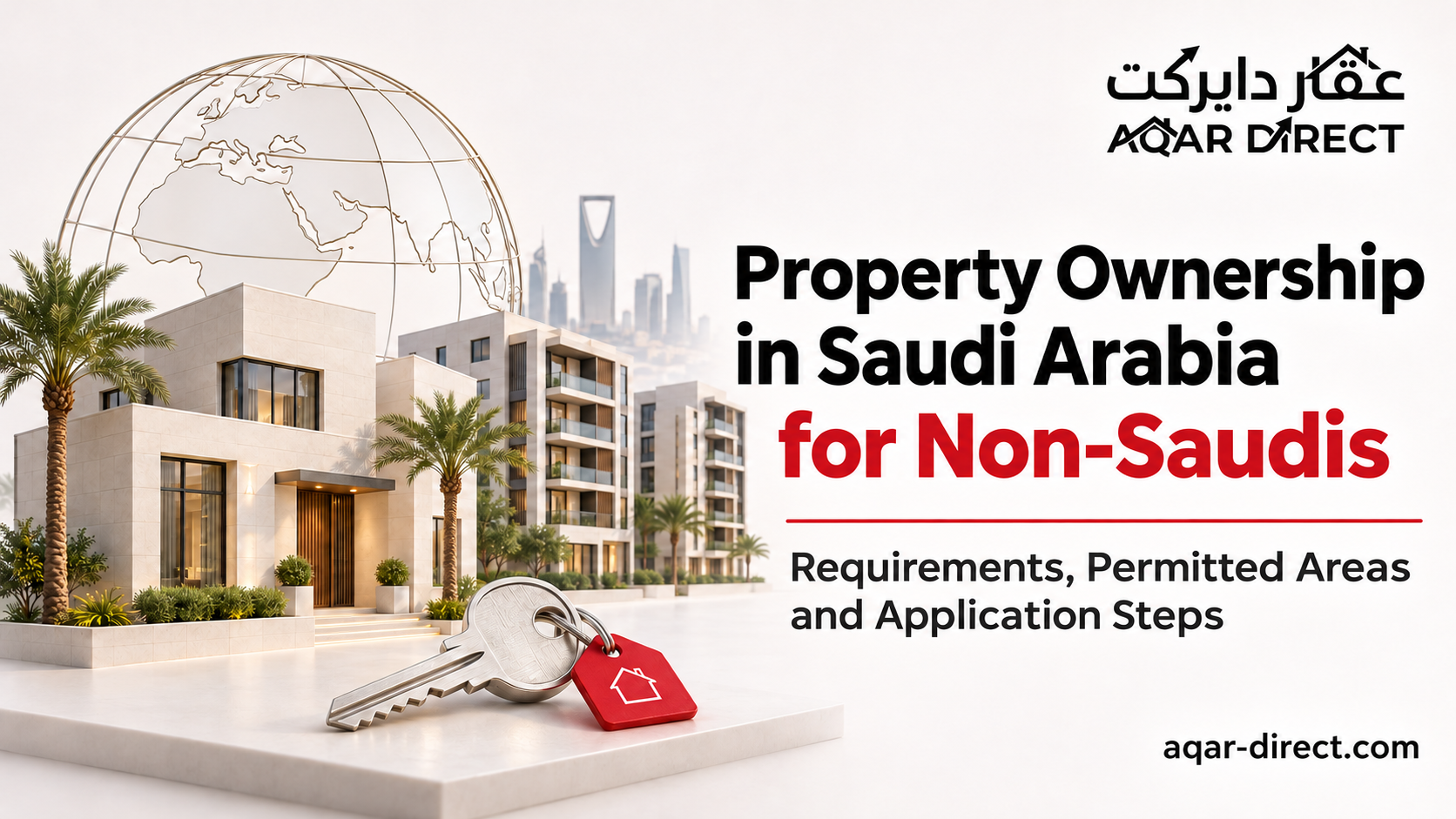
Buying property in Saudi Arabia is available to eligible non-Saudi buyers under the updated framework. Choosing a suitable property starts with three checks: your eligibility, the permitted location, and the property right being offered.
Applications are submitted through the official Saudi Properties portal. Requirements depend on the applicant’s category and the rules governing the property’s geographic zone. Source: Real Estate General Authority
This Aqar Direct guide explains the pathways for residents, non-residents and companies, how to check permitted areas, and the practical steps before applying.
Who can apply to own property in Saudi Arabia
Application pathways cover residents, non-residents, companies and eligible entities. REGA announced that the updated law took effect on 22 January 2026, with different procedures for each category. Source: REGA announcement published by the Saudi Press Agency
Residents of Saudi Arabia
Residents can apply through the portal using their Iqama number, subject to eligibility checks. Source: REGA announcement
Prepare your identification and contact details, and decide whether you are buying a personal home or an investment. This helps you select the appropriate pathway and understand its restrictions.
Individuals living outside Saudi Arabia
Non-residents need a digital identity, a Saudi bank account in their own name, and a Saudi mobile number registered to them and linked to that identity. Source: Article 2 of the Implementing Regulations
Start the approved digital identity process before committing to a purchase. REGA’s announcement directs non-residents to Saudi diplomatic missions and embassies for this initial step, followed by the online application. Source: REGA announcement
Companies and other entities
Foreign companies need Ministry of Investment registration, direct and indirect ownership disclosure, an appropriately identified representative, and a Saudi bank account in their name. Source: Article 3 of the Implementing Regulations
First establish the entity’s place of incorporation and legal status. A foreign company and a Saudi-incorporated company with foreign shareholders do not necessarily follow identical requirements. Check the representative’s authority and the required documents with a legal adviser before contracting.
Where can non-Saudis own property
The Saudi Properties zones map identifies approved locations and provides information on permitted rights, ownership limits, applicable durations and zone conditions. Source: REGA programme page
Riyadh and Jeddah
Ownership is available through approved zones, subject to the property types and rights permitted there. A Riyadh or Jeddah address alone does not establish eligibility. Source: REGA ownership guide
Request the exact location and parcel or unit details. Being advertised as “near an approved development” does not demonstrate that the property lies within its boundaries.
Makkah and Madinah
Individual non-Saudi buyers must be Muslim and comply with the applicable zones and special conditions. Eligible Saudi companies are governed by their own provisions. Source: REGA ownership guide
Check the property type, permitted use and available right through the portal before choosing a unit, particularly when an advertisement uses a broad description such as “an ownership opportunity in Makkah.”
Other cities and developments
Check the official map for the specific property in any city or development. Do not assume that an eligibility finding for one property applies to another, even in the same neighbourhood.
Record the zone name, available right and date of your check, then compare them with the property documents. Seek official clarification before making a binding payment if the boundaries or conditions are unclear.
Can a resident own a home outside the approved zones
A lawful resident may own one property for personal housing outside the designated zones, excluding Makkah and Madinah, subject to the applicable conditions. Source: Article 2 of the Law
This pathway restricts dependants’ separate housing ownership, with exceptions when marriage ends or a descendant reaches 25; non-Saudi spouses and descendants count as dependants. Source: Article 7 of the Implementing Regulations
Confirm that this pathway applies to your circumstances before relying on it in negotiations. It should not be treated as general permission to build a property portfolio outside the zones.
How to apply for property ownership
REGA’s guide sets out a journey covering applicant classification, document preparation, zone verification, property selection, application and registration. Source: Ownership guide
1 Identify your category and purchase purpose
Identify your category and whether you are buying personally or through an entity. GCC nationals and Premium Residency holders may have more favourable rights under separate provisions. Source: Article 5 of the Law
2 Prepare the applicant and property documents
Depending on your category and the portal’s requirements, prepare:
Identification, residency or digital identity details.
Relevant contact and bank account information.
Entity registration, representation and ownership disclosures for a company purchase.
Title deed or property registration details, location and the right being acquired.
Check that names and identification numbers match across the documents. Confirm whether foreign documents require translation or authentication under your pathway.
3 Verify the location and right before final negotiations
Use the official map to match the property to the zone boundaries. Establish whether the offer involves ownership, usufruct or another property right. For a time-limited right, check its duration and obligations.
Assess the price against the actual right, usable area and ongoing costs, as well as the property’s presentation.
4 Submit through the official portal
Visit Saudi Properties, follow the route for your category, enter the requested information and review the declarations before submission. Keep your application reference and document copies, and respond to requests for additional information.
5 Agree the contract and payment conditions
Address what happens if ownership eligibility is not satisfied, financing is declined or an important defect is discovered. Set out deposit terms and completion deadlines. Obtain written terms rather than relying on an advertiser’s verbal assurance that approval is guaranteed.
Related financial transactions must use electronic payment methods, while ownership procedures and title issuance are completed through the Real Estate Registry. Source: REGA guide
6 Check the final registration
After completion, review the right holder’s name, property description, type of right and registered restrictions. Registration in the Real Estate Registry is a condition for valid ownership under the law. Source: Article 8 of the Law
What costs should buyers consider
Budget for the property price, brokerage, inspection, valuation, financing and recurring service charges. Real Estate Transaction Tax is 5% for taxable transactions, subject to applicable exemptions. Source: Zakat, Tax and Customs Authority
A separate non-Saudi disposal fee is 2% in Riyadh, Makkah, Madinah and Jeddah Governorate, with zero-rated cases. Confirm applicability and liability. Source: Articles 9 and 10 of the Implementing Regulations
Request a written cost breakdown showing who pays each amount and when. This makes it easier to compare properties with similar advertised prices but different total costs.
Frequently asked questions
Does buying property grant Saudi residency
Ownership alone does not automatically grant residency. Property rights do not create additional privileges beyond those provided by law. Source: Article 6 of the Law
Does a property advertisement mean I am eligible to buy
Check both the property and your applicant category through the official channel. Use the advertisement to identify an opportunity, then verify the documents, location and conditions before committing.
How long does approval take
Check the timeframe published for your pathway in the portal and allow for requests to complete the documentation. Make contractual deadlines reflect the application outcome rather than relying on an unconfirmed completion date.
Compare properties and verify before committing
Explore suitable options on Aqar Direct, comparing location, area, price and total cost. Once you have a shortlist, verify buyer and property eligibility through Saudi Properties before completing the inspection, contract and registration.
For a company purchase or a property subject to special conditions, obtain legal advice on the contract and ownership pathway before making a binding commitment.